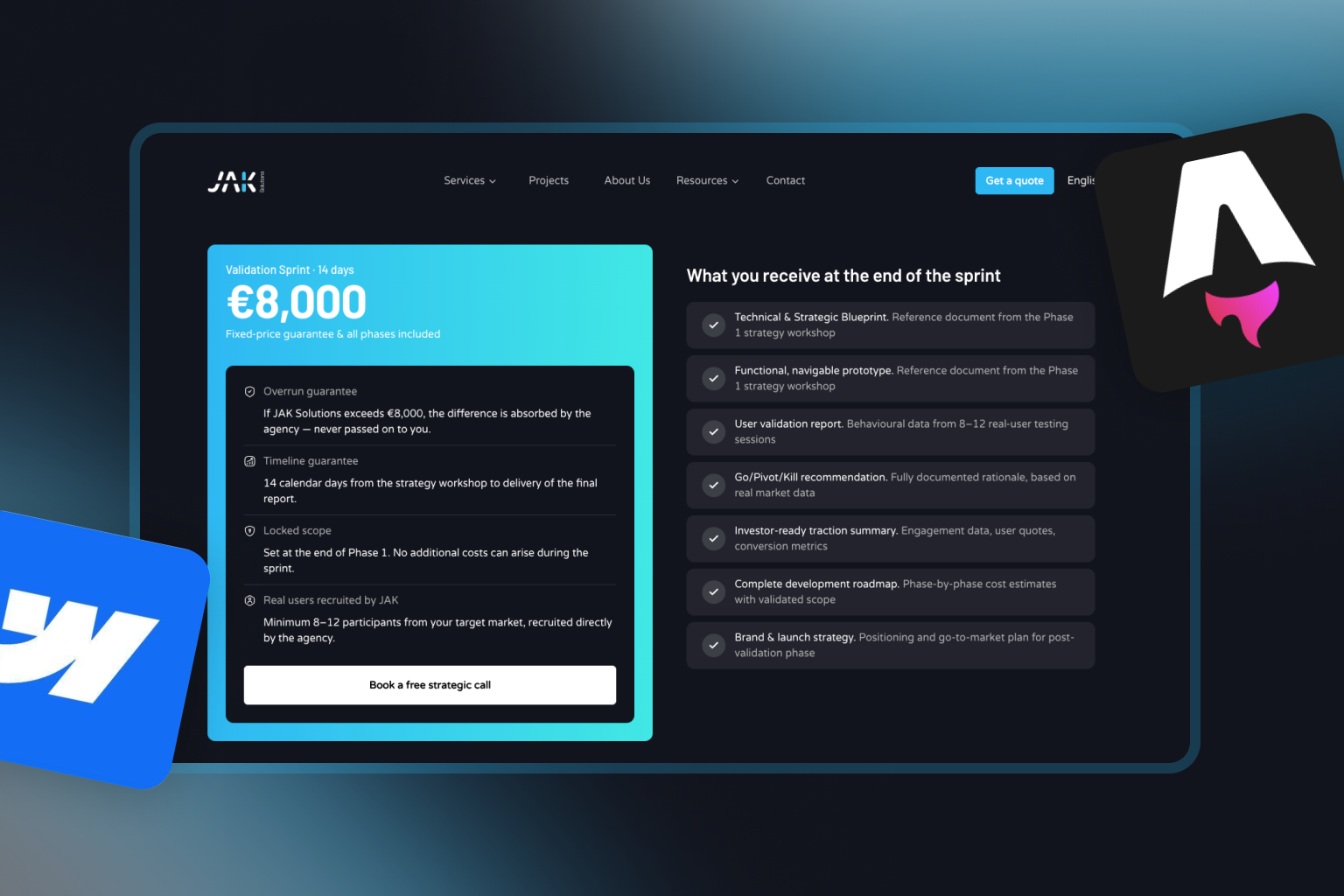



In short: in Belgium, the price of a custom web application ranges from 5,000 euros for a small targeted internal tool to over 100,000 euros for a full client-portal platform. Three factors drive the bill the most: the functional scope, the integrations with existing tools, and the number of user roles. A freelance developer typically charges between 400 and 600 euros per day in Belgium, a structured agency between 600 and 1,000 euros per day. At JAK Solutions, a Brussels-based agency, most projects start with a fixed-price 14-day validation sprint at 8,000 euros, designed to test the concept before committing to a full development budget, which generally sits between 60,000 and 200,000 euros for a finished application or SaaS.
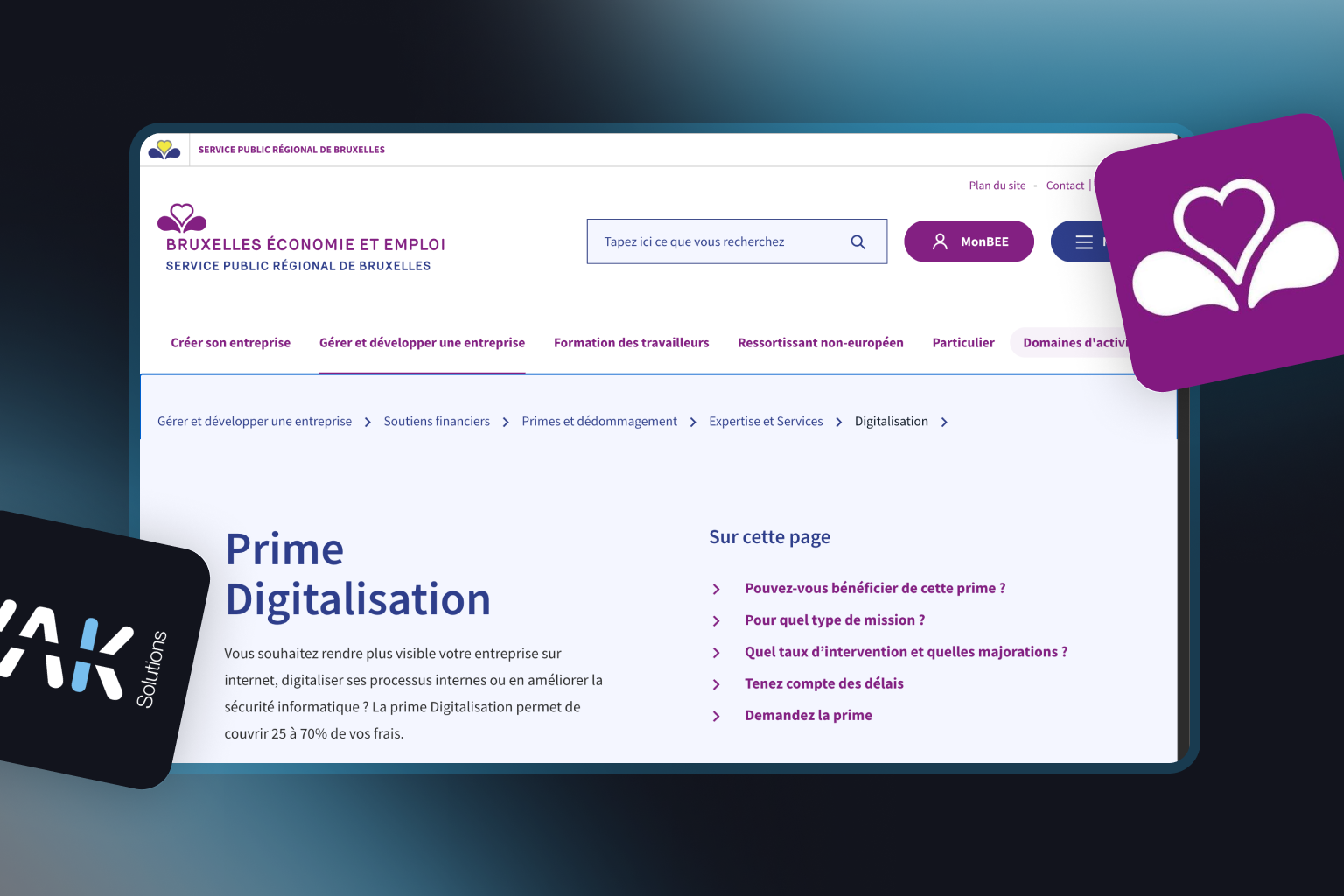
The price of a web application has little to do with the price of a showcase website: here, you are not paying for pages but for business logic, calculation rules, user roles and, often, integrations with tools already in place (accounting, CRM, ERP). That is why two projects that look similar on paper, a job-site management tool or an invoicing tool, can cost 10,000 euros or 80,000 euros depending on their functional depth. Brussels-based SMEs have one lever to lighten that bill: the Brussels Region digitalisation grant specifically covers the digitalisation of internal processes, up to 70% of the amount spent and 10,000 euros per year. This guide breaks down the real price ranges by project type, what makes the price vary threefold, and where JAK Solutions' own rates sit.
What determines the price of a custom web application?
The price of an application depends on four factors that combine, in an order of impact that stays fairly consistent from one project to the next: the functional scope (the number of screens, business rules and edge cases to cover), the integrations with tools the company already uses (accounting, CRM, ERP, industry-specific tools), data migration when the application replaces an existing system or a set of spreadsheets, and the number of user roles to manage (a single-purpose internal tool costs noticeably less than a platform with different permissions for clients, field teams and administrators).
A fifth factor, less visible on the initial quote but decisive over time: the type of provider. A freelance developer typically charges between 400 and 600 euros per day in Belgium, a structured agency between 600 and 1,000 euros per day. The gap does not only reflect a different hourly rate: an agency pools several areas of expertise (architecture, design, security, maintenance) on the same project, where a freelancer carries every technical decision alone, from the database choice to security patching.
How much does a small internal tool cost?
A targeted internal tool answers one specific need: automating a tracking process, replacing a shared spreadsheet, centralising a contact database. It is the cheapest entry format because the functional scope stays limited and it usually involves only one type of user.
- Simple tool (a form, a database, a basic dashboard): between 5,000 and 10,000 euros.
- Tool with business logic (calculation rules, automatic notifications, document generation): between 8,000 and 15,000 euros.
This is the best-suited format for a first digitalisation step, before investing in a more ambitious tool once the need has been validated in the field.
How much does a full management tool cost?
A full management tool covers several linked processes, quoting, invoicing, scheduling, client tracking, in a single application. It is the most common category among Belgian SMEs looking to move away from a stack of generic tools (a spreadsheet, a separate invoicing tool, a shared calendar) toward one system built for their trade.
Budget between 15,000 and 50,000 euros depending on the number of modules and the complexity of the business rules. A management tool for a regulated trade (specific accounting, sector-specific VAT, traceability standards) usually sits at the upper end of this range, a generic management tool for a services SME at the lower end.
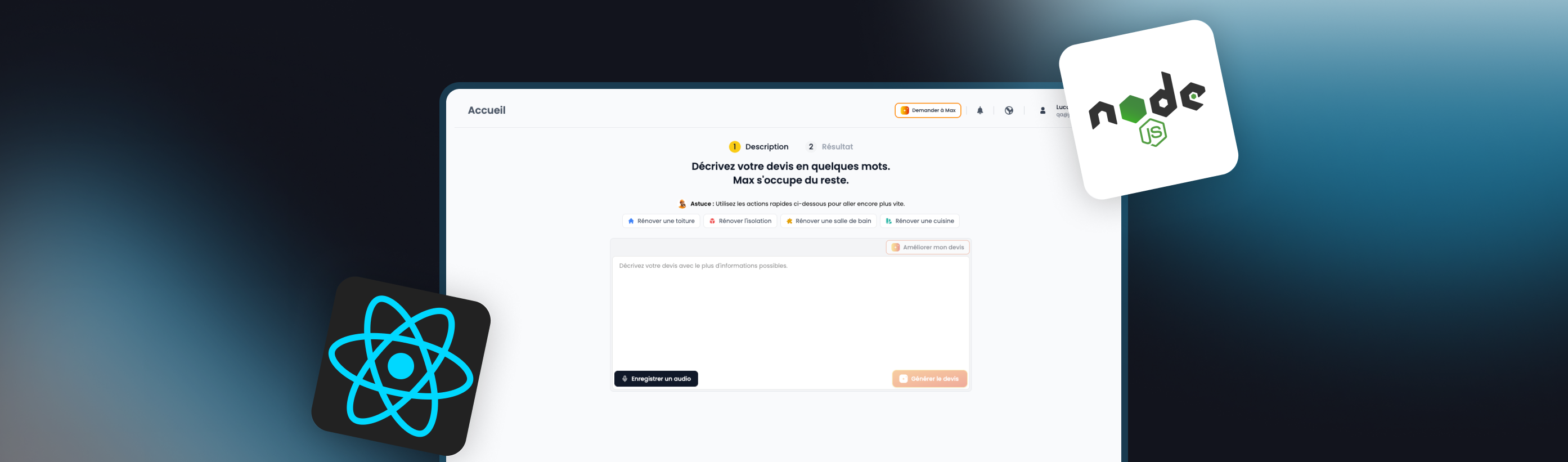
This is exactly the format built for Cobria, the application JAK Solutions developed for construction professionals: quoting, invoicing, scheduling and job tracking brought together in a single interface, with a built-in AI assistant that generates complete quotes in seconds. Measured result: 3 minutes saved per quote generated, on a tool now used daily by independent contractors and construction businesses.
How much does a client-portal platform or a SaaS product cost?
A client-portal platform adds a further layer of complexity: managing multiple accounts, different permissions across profiles, and often an architecture designed to host several client companies (multi-tenant) if the project is meant to become a sellable product rather than an internal tool.
- Simple client portal (secure access, personalised dashboard, document exchange): starting at 40,000 euros.
- Full SaaS platform (multi-account, integrated billing, API, scalable architecture): between 60,000 and 200,000 euros depending on scope, with no real ceiling for the most ambitious projects.
MyImpactTool illustrates this exact path: born as an internal impact-reporting tool for an events client, it evolved with JAK Solutions into a genuine SaaS product, now used in 15 countries. That is the typical trajectory of a project that starts as a management tool and grows into a sellable platform once the need is validated beyond the walls of the originating company.
| Format | Price range |
|---|---|
| Targeted internal tool | 5,000 - 15,000 € |
| Full management tool | 15,000 - 50,000 € |
| Client portal / SaaS platform | 40,000 - 200,000 € |
| JAK Solutions validation sprint | 8,000 € fixed price (14 days) |
Custom-built or off-the-shelf: which wins over time?
Before pricing a custom development, the question that usually gets skipped is whether an off-the-shelf solution would not do the job. A generic SaaS subscription (project management, CRM, invoicing) typically costs between 20 and 200 euros per month and per user, a figure that looks trivial next to a 20,000 or 50,000 euro custom build.
The maths changes over time and as the team grows. A 50 euro per month, per user subscription for a 15-person team adds up to 9,000 euros a year, so roughly 45,000 euros over five years, without counting the recurring price increases SaaS vendors apply and the structural limits: no way to adapt the tool to a specific business process, full dependency on the vendor's own roadmap, and no ownership of the system once the subscription ends. A custom tool has a higher entry cost, but becomes company property, fits the actual business rather than the other way around, and carries no per-user cost that climbs with team growth.
The right call depends on the process in question: a generic, standard need (accounting, payroll) is almost always still better served by an existing, certified solution. A process that defines what makes the business distinctive, or that has no satisfying equivalent on the market, justifies a custom build. That is precisely the logic behind helloJAK, the ERP built in-house by JAK Solutions: common base modules for any business (clients, offers, invoices), completed with custom modules per trade, rather than forcing the business to adapt to a standard piece of software.
Why validate before you build?
The number one cause of software project failure is not technical. According to a CB Insights study on why startups fail, 42% of failures come down to no real market need, well ahead of running out of budget or a weak technical team. In other words, the first financial risk of a web application is not building it badly, it is building the wrong application.
That is the logic behind the JAK Solutions validation sprint: 14 days at a fixed price of 8,000 euros, any overrun absorbed by the agency, to test the concept with 8 to 12 real users before committing to a development budget that runs into tens of thousands of euros. The method follows four steps: strategy definition, prototype design, user testing, then a documented Go, Pivot or Kill recommendation. Against a full development budget estimated between 60,000 and 200,000 euros, spending 8,000 euros to confirm the project answers a real need changes the level of risk taken on directly.
What costs continue after development?
The development price is only the first expense of a web application. Unlike a showcase website, a custom application carries higher recurring costs, tied to hosting, ongoing maintenance and security.
| Item | Typical cost |
|---|---|
| Cloud hosting (database, servers) | 50 - 300 € / month depending on load |
| Corrective and evolutive maintenance | 500 - 2,000 € / month depending on the application's size |
| Security updates and audits | Variable, to budget from the design phase |
| User support | Included or billed separately depending on the provider |
Security deserves particular attention: a custom web application often handles sensitive data (invoicing, client data, sometimes GDPR-covered personal data). Following recognised frameworks such as those from OWASP, the reference organisation for application security, is a baseline practice to expect from any provider, freelance or agency. A development budget with no audit and no regular update exposes the business to a risk that, if an incident happens, costs far more than the budget line saved at the start.
Freelance or agency: which one for a web application?
The choice between freelance and agency affects both the price and the risk carried by the project. A freelancer charges between 400 and 600 euros per day and suits a simple internal tool, with a stable scope and few integrations. A structured agency charges between 600 and 1,000 euros per day, but brings together several areas of expertise (technical architecture, design, security, AI integration) that become risky to carry alone as an independent as the project grows.
At JAK Solutions, development runs on a proven technical stack: React and Node.js on the application side, .NET Core for enterprise architectures, PostgreSQL for the database, scalable cloud hosting. The same team that builds the application then handles its ongoing development, a continuity point that matters particularly for an application meant to evolve over several years.
This continuity matters more than it seems on a freelance project: if the independent developer who built the application is no longer available, picking up unfamiliar code often costs more than starting over, especially if the technical documentation was not kept up to date. A structured team, with several developers able to work on the same project, reduces this single-person dependency risk, a point worth checking before signing any quote, whichever provider is chosen.
For Brussels-based SMEs, one last point changes the budget maths concretely: the Brussels digitalisation grant specifically funds internal process digitalisation projects, up to 70% of the amount and 10,000 euros per year. Part of the budget for an internal or management tool, as described above, can therefore be directly covered by this regional grant.
Conclusion: price the risk before you price the development
The price of a custom web application in Belgium ranges from 5,000 euros for a targeted internal tool to over 100,000 euros for a full SaaS platform, with a typical management tool between 15,000 and 50,000 euros. The right instinct is not to compare development quotes first, but to validate the concept before committing the budget: 42% of software projects fail for lack of a real need, a risk that costs far more than a validation sprint.
JAK Solutions offers a risk-controlled entry point: a fixed-price 14-day validation sprint at 8,000 euros, before any commitment to full development.