


A grant most Brussels SMEs never claim
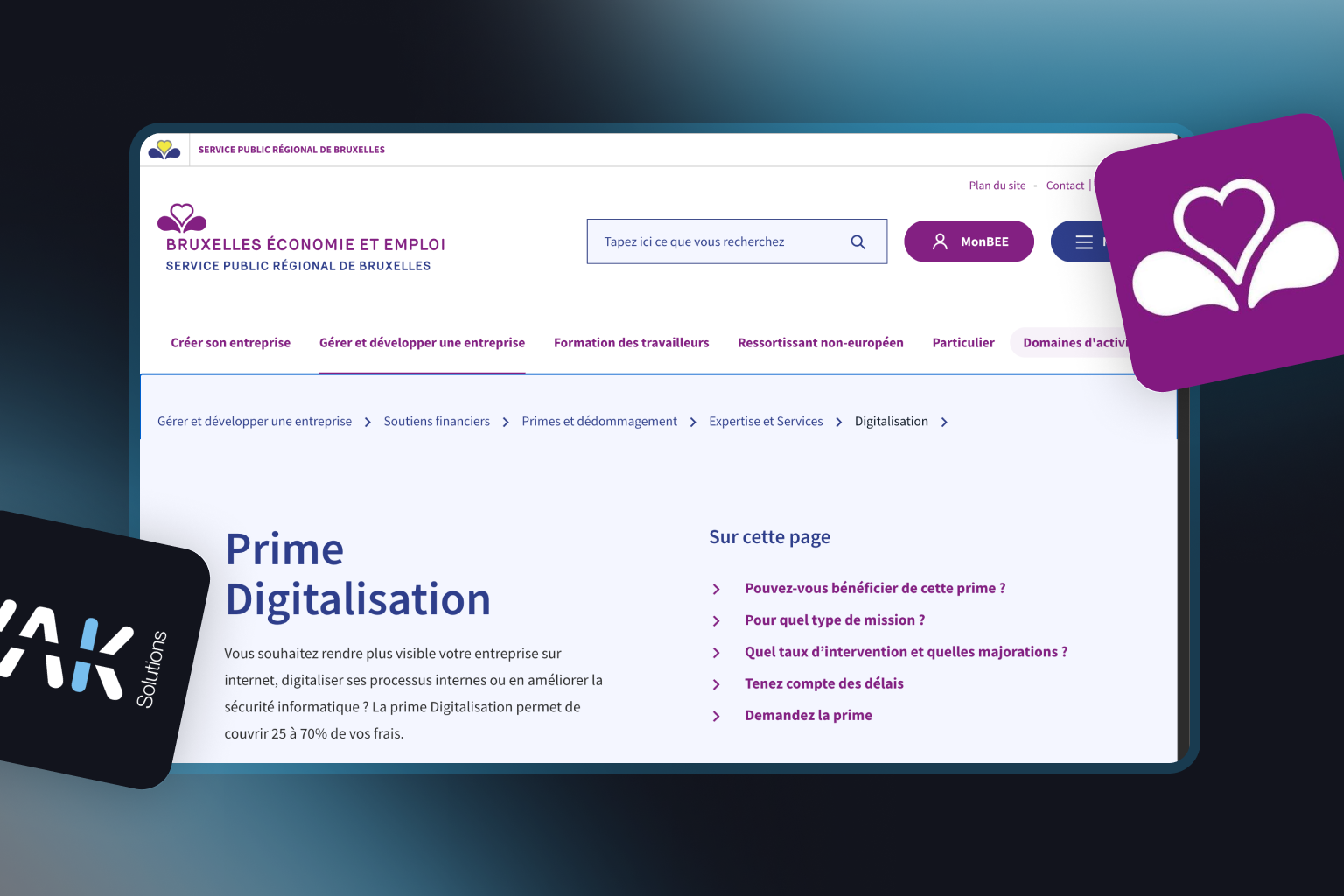
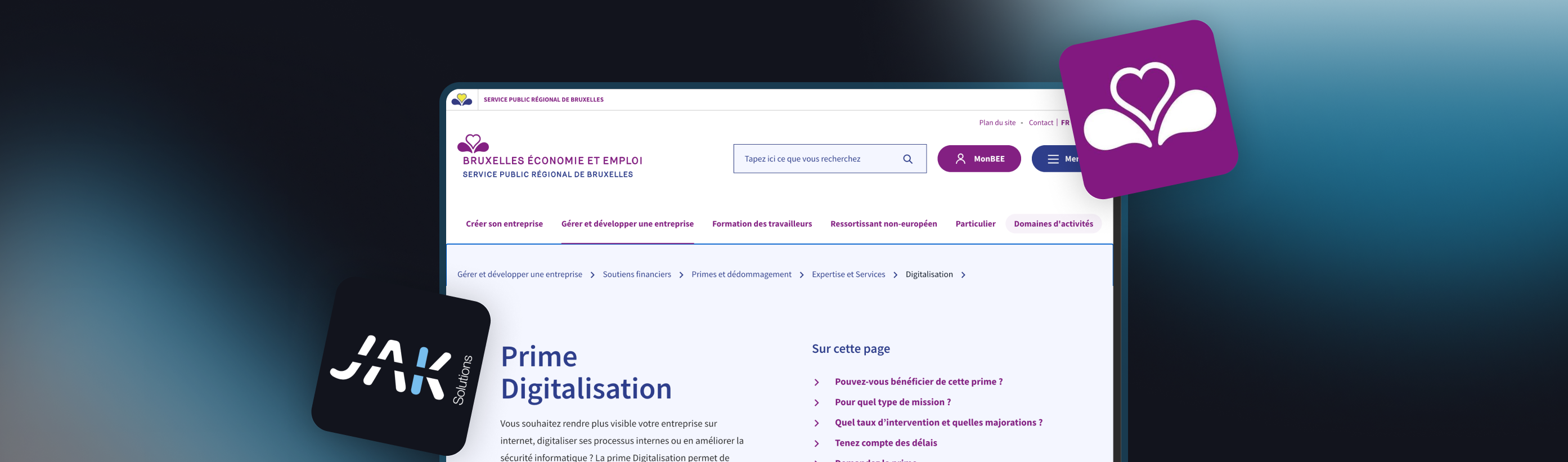
The Brussels digitalisation grant exists precisely for the project a small business keeps postponing: a website that needs rebuilding, a manual process that should be automated, a security gap that should be closed before it becomes a problem. It reimburses part of the cost of hiring an outside consultant to carry out that project, within a strict but manageable set of rules.
It is administered by Bruxelles Économie et Emploi, the regional economic administration, and it exists alongside a related grant, the Prime Consultance, which funds other categories of external advice. The two do not stack on the same project, but a business can use one for one need and the other for a different need within the same year.
What the grant actually covers
Three categories of consulting missions qualify, and nothing outside them does.
Digitalising internal processes: replacing a manual spreadsheet with a dedicated tool, centralising scattered data, automating a repetitive task. IT security: an audit, an access review, data protection improvements. Website development or technical improvement: a rebuild, a technical or SEO upgrade, a new platform.
One detail most guides on this topic skip: the text does not impose a technology. A custom web application, an SEO-driven Webflow site and a FileMaker integration all qualify equally, as long as the mission is properly scoped and invoiced by an independent consultant.
Who qualifies, and who does not
Eligible businesses must be an SME or self-employed professional with at least one operating seat in the Brussels-Capital Region, active in an eligible sector, registered with the Belgian Crossroads Bank for Enterprises, and up to date with annual account filings. They must not be more than 75% publicly funded, must stay under 300,000 euros of de minimis aid over three years, and need a diversity plan if they employ more than 50 people.
In practice, the large majority of ordinary Brussels SMEs and self-employed professionals clear this bar without difficulty. The exclusions target heavily subsidised or very large structures, not the typical small agency, shop or non-profit weighing whether to invest.
How much you can actually get back
The base reimbursement rate is 25% of eligible costs, capped at 10,000 euros per business per year across a maximum of two missions, with a minimum intervention of 500 euros per file.
Three bonuses stack on top of that base rate: a starter bonus for businesses under four years old (up to 25% extra for micro and small companies, 20% for medium ones), and equivalent bonuses for demonstrated environmental or social practices. A young, sustainability-minded small business can combine several of these and approach the 70% ceiling.
The two numbers work together, not separately. On a 15,000 euro mission, a 70% rate would in theory return 10,500 euros, but the annual 10,000 euro ceiling caps it first: past roughly 14,300 euros of eligible spend at the maximum rate, the ceiling decides the payout, not the percentage.
Where the proof already exists
The grant rewards concrete missions, not vague “digital transformation” promises, which is exactly where a track record matters more than a pitch. On the internal-process category, JAK Solutions delivered Cobria, cutting quote generation time by three minutes per file. On the website category, Saint-Vincent de Paul got a one-click automated annual report through a custom-built platform. On IT security, the proof is procedural rather than a single project: every JAK development starts with a technical review of access, data handling and dependencies before a single line of code is written.
“Protéine’s staff used to apply for events by email and spreadsheet. We digitalised the whole process and connected it to their existing FileMaker system, and the grant covered a real share of that mission,” says Kim Berthonneau, CEO of JAK Solutions, about the Protéine project.
How to apply without losing the grant on a technicality
The order of operations is strict, and the most common mistake is starting the project before the file is approved.
First, confirm eligibility with Bruxelles Économie et Emploi or the 1819 business information line. Second, choose an independent consultant who meets the criteria: consulting as a primary activity, at least two years of experience, verifiable references. Third, submit the request before incurring any cost, at the latest the day before the mission starts. Fourth, run the mission within a window from the day after the request to three months after approval, for a maximum duration of six months. Fifth, submit the supporting documents within twelve months of the approval notice.
A file submitted after the project has already started is rejected without exception, regardless of how good the work turns out to be.
Choosing the right consultant for the mission
The grant funds a consultant, not just any provider, and three questions separate a serious candidate from someone discovering the grant at the same time as the client.
Can they show comparable missions with measurable outcomes, rather than a generic transformation pitch? Do they adapt the solution to how the business actually works, instead of fitting it into a template built for someone else? And can they cover the full range, from a website rebuild to a custom internal application, so a second project a year later does not mean starting over with a different provider?
Why work with JAK Solutions
Applying for this grant is a formality once the project itself is clearly scoped. The harder part is defining a mission that genuinely fits one of the three eligible categories, sized correctly against the 10,000 euro ceiling, and delivered by a consultant who can actually be checked against real, comparable work.
That is the part JAK Solutions helps with directly. Nineteen delivered projects across thirteen sectors give a basis for comparison that a generic pitch cannot match, and the same team that can scope a grant-eligible mission can also carry it out end to end, whether that means a website project, a custom internal tool, or the security review that should come before either.
Talk to JAK Solutions about your project before filing anything, so the mission is scoped correctly from the start rather than corrected after the fact.